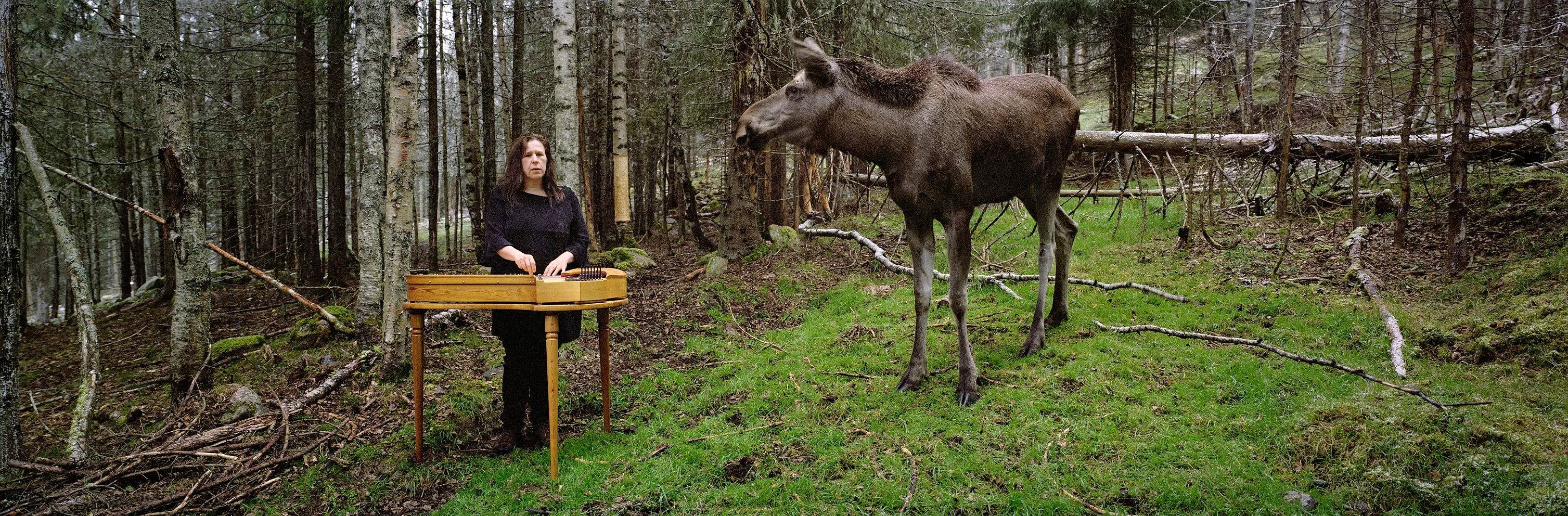
Sinikka Langeland is a singer, kantele player, and composer based in Finnskogen, Norway.
Thanks to her remarkable vocal and kantele playing technique, she has been described as sounding like an entire orchestra on her own. Sinikka has recorded her music for the legendary label ECM Records since 2006.
She was born in Kirkenær in southeastern Norway in 1961, and studied piano, guitar, and song. In 1981 she discovered the kantele, which would become her primary musical focus alongside singing. In the 1980s, she also devoted herself to theatre work and studies at Ecole Jacques Lecoq in Paris, in search of new approaches to developing her creativity. This led her back to music and to studies in folk music, dance, and musicology at the University of Oslo, where she graduated in 1992. She then embarked on an extensive research project, exploring archives in search of traditional music from Finnskogen. Collaboration with other folk singers, musicians, and producers was a highly fruitful part of this work, among whom Ove Berg was the most important – sound engineer and producer for the label Nordic Sound. Ove Berg’s outstanding recordings in Grue Church of Sinikka singing medieval ballads, Strengen var af røde guld and Lille Rosa, released by Grappa Musikkforlag, were both nominated for the Spellemann Award.
Sinikka’s songs often explore the relationship between humans and nature. With her first solo CD in 1994, Langt innpå skoga, she began a decade-long collaboration with Helge Westbye from Grappa Musikkforlag. She followed up with Har du lyttet til elvene om natta in 1996, featuring newly composed music to poetry by the lumberjack Hans Børli. In 1996 she received two awards: The Finnskog Award and The Varden Award.
Between tours, Sinikka returns to her beloved Finnskogen. Finnskogen was settled by the Forest Finns in the 17th century, who today hold the status of a national minority in Norway. Sinikka’s Finnish roots come from her mother Aila, who is from Karelia. Finnskogen is rich in myths, beautiful landscapes, and wildlife, and this, combined with the presence of a community actively working to promote art and culture, contributed to her decision to settle in Svullrya in 1992. The Finnish language is no longer spoken in the area, but the old rune songs carry the Forest Finnish language and a remarkable poetry rooted in an ancient magical forest culture. Her determination to revive the rune songs resulted in the book Karhun emuu and the CDs Tirun lirun and Runoja. Tore Hansen’s paintings and illustrations for her books and CDs represent a powerful contribution from one of Norway’s most highly regarded artists. Sinikka was awarded the Edvard Prize for Runoja and the Norwegian-Finnish Culture Prize in 2003 together with Ove Berg. In 2010 she received the Rolf Gammleng Prize and in 2012 the highly prestigious Sibelius Prize.
The rune songs contain some Christian elements, but after discovering folk variants of Kyries as well as several old versions of hymns, Sinikka took on the challenge of exploring the development of these early hymns within Norwegian folk singing traditions, compared with J. S. Bach’s organ chorale arrangements from the same sources. This project resulted in five recordings and numerous concerts in both large and small churches in Norway, Poland, Russia, Holland, and Belgium, together with organist Kåre Nordstoga and violist Lars Anders Tomter.
During Sinikka’s youth, the nearby town of Kongsvinger was home to a major music festival. She herself led a folk club called «Den vesle svarte Æljen» and traveled around performing her songs. The Kongsvinger Festival gave her one of the first stages she performed on, and also allowed her to hear accomplished jazz musicians such as Jan Garbarek, Radka Toneff, and Arild Andersen. She began setting music to Hans Børli’s poetry, and still performs some of these works in new arrangements.
Tradition
Sinikka Langeland’s songs often explore the relationship between humans and nature as expressed in traditional and modern poetry. She lives in Finnskogen, 140 km north of Oslo near the Swedish border. Finnskogen was settled by Forest Finns in the 17th century and today holds the status of a national minority in Norway. In 2025, the new Norwegian Forest Finnish Museum opened, and as part of the opening, Sinikka’s music was arranged for her ensemble and KORK and performed at an outdoor concert in Svullrya with 1,350 attendees.
Singing Style
Sinikka’s singing style is characterized by both rune singing and kveding (traditional vocal technique), while also carrying a timeless and distinctive quality in her interpretations of both old and new poetry.
«Being in a room with Sinikka Langeland is like being charmed into a northern forest under a night sky,» wrote Fiona Talkington in Songlines. «Her presence and her voice are magical, but when she plays her kantele you can almost feel nature itself quivering with joy.»
The Kantele
The kantele is a string instrument played in regions where Finno-Ugric languages are spoken. Sinikka plays a concert kantele with 39 strings. It is built by Hannu Koistinen and can be tuned in all keys, with many possibilities across its 5 octaves. The oldest type of kantele has 5 strings, and five-tone melodies are varied through improvisation. Singing and kantele playing complement each other, and she has often been described as if she sings through her instrument.